What extracting data from a filing actually costs in 2026
I ran nine language models over 2,280 real SEC filings, the four types that span the difficulty range: 8-K current reports, 10-K risk and MD&A sections, proxy-statement compensation tables, and earnings releases. Same field specification each time, same schema, every call's token usage and cost recorded. Then I looked at what the extraction actually costs at published list prices.
It costs almost nothing, and it costs almost exactly the same amount every time you run it.
The flagship model in the set extracts a routed 10-K for twenty cents, a proxy statement for a quarter, and an 8-K for two cents. The fast tier runs about a third of that. Capable open-weight models run one to three cents a document. The single most expensive cell in the whole benchmark, the flagship on a dense proxy statement, is twenty-five cents. The floor is a tenth of a cent.
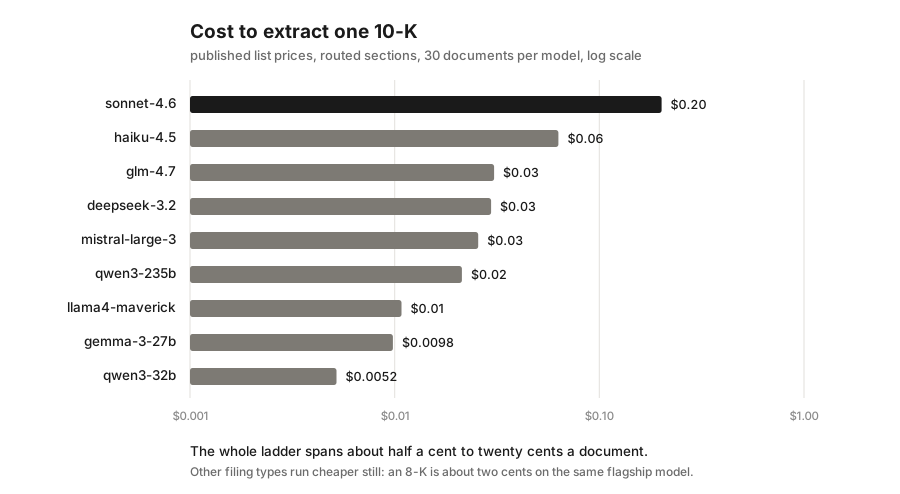
Two things turn this from a budgeting question into a settled one.
The first is that the numbers barely move. Across five identical repeats of the full run, the standard deviation of per-document cost never exceeded six hundredths of a cent. You can estimate the cost of a job from a single run and be right, because the run-to-run variation is smaller than the printed digits.
The second is the scale it implies. A thousand routed 10-Ks on the flagship is about two hundred dollars at list price, a hundred in batch mode, sixty-three on the fast tier, and eleven dollars on an open-weight model. Sending only the sections you actually want read, rather than the whole filing, halves the 10-K cost with no measurable loss of quality. Extraction cost is not the line item worth arguing about anymore.
So if cost is solved, where did the difficulty go?
It went to the only question left, which is whether the output is any good. That turns out to be much harder than the extraction itself, and much more expensive to answer, and it is where almost nobody is looking. One of the cheaper models in this set returned clean, correctly-shaped JSON on every long document I gave it, with nothing inside. On any benchmark that scored cost and format alone, it would have looked like a bargain.
That is the subject of the next piece. For now the useful fact is the plain one: the extraction is close to free, and what you actually pay for is not knowing whether to trust it.