What LLM Document Extraction Actually Costs in 2026
A reproducible benchmark on public SEC filings. Nine models, four document types, 2,280 extractions, every call’s tokens, cost, latency and schema-validity recorded.
What it answers
If you point a current model at a real filing with a real field specification, what does one document cost, and what do you actually get back?
The short version
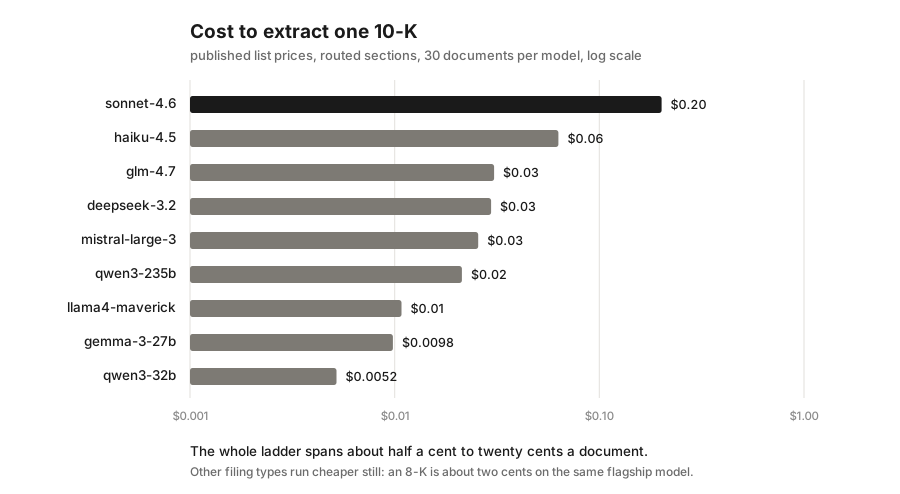
Extraction costs pennies, and it costs almost exactly the same amount every time you run it. The flagship model here extracts a routed 10-K for about twenty cents, a proxy statement for a quarter, an 8-K for two cents. Capable open-weight models run one to three cents. Across five identical repeats the standard deviation of per-document cost never exceeded six hundredths of a cent, so a single run gives you a reliable estimate.
The scarce thing is not the extraction. It is knowing whether the extraction is any good. On the hardest document type in this corpus, 199 of 540 outputs across nine models failed schema validation. One of the cheaper large models returned syntactically clean, correctly-shaped JSON on every long document it saw, with nothing in it, and a benchmark that scored only cost and format would have called that a bargain.
Cost is a solved, nearly deterministic quantity. Measurement is the part you still have to build.
What is in it
The cost ladder by model and document type at published list prices. Schema-validity and context-overflow reported as first-class results for every model, with no failing row dropped. Cross-model consensus per field group, scored against a same-model repeat-agreement noise floor. Two levers measured: section routing (halves 10-K cost at unchanged validity) and adaptive thinking (buys validity on the hardest type at roughly 3x). Evidence-quote grounding rates. And an explicit statement of the boundaries: validity is schema conformance, not factual accuracy; consensus is agreement, not ground truth.
Who it is for
People running document extraction in production who need to answer, to a board, an auditor, or themselves, how they know the output is right. Everything is re-derived from public documents, with a frozen seeded corpus, committed prices with retrieval dates, and a per-call ledger, so you can reproduce it or argue with it.
Read it
- The benchmark reportPDF · the full result set, figures, and caveats
- The methodology companionPDF · corpus, harness, cost basis, validation accounting, limitations
Both are open downloads. No form, no email required.
If you are running extraction in production and need to answer how you know the output is right, book a 30-minute call and we can talk about what measuring it would take in your setting.